


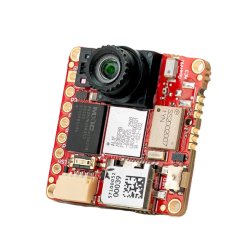
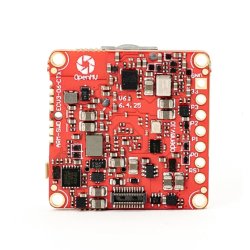
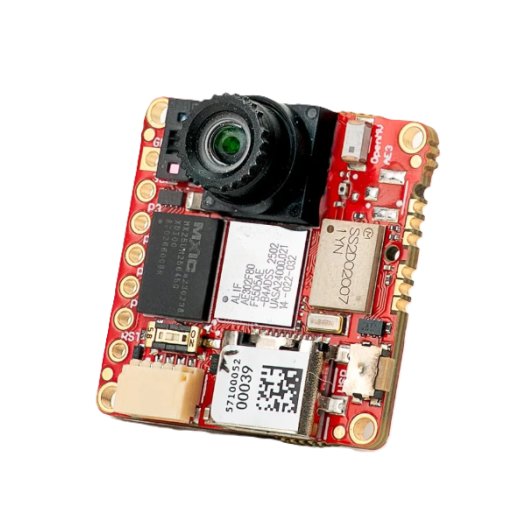
OpenMV AE3
- SKU: MBS-ENTB-146
- GTIN: 05390368407166
- HAN: OMV-AE3-V1
- Category: Development Boards
-
Manufacturers:

OpenMV AE3
- AI camera, 30 × 30 mm, with two NPUs
- 1 MP global shutter, up to 240 FPS
- Time-of-flight sensor, IMU, microphone, Wi-Fi and Bluetooth
- Programmable in MicroPython
Description
OpenMV AE3
The OpenMV AE3 is an AI camera on a board measuring just 30 × 30 mm and weighing 8 g. Camera, two NPUs, time-of-flight sensor, IMU, microphone, Wi-Fi and Bluetooth all sit on one board. The AE3 is built for on-device image processing and embedded AI, for example in robots, drones, inspection systems or IoT applications. You program it in MicroPython instead of C/C++.
At its heart is the Alif Ensemble E3 with two Arm Cortex-M55 cores and two NPUs delivering around 250 GOPS combined. That is enough to run YOLO object detection at 30 FPS alongside speech recognition, at a power draw of only 0.25–0.3 W.
Highlights
- Powerful edge AI: two NPUs (204 + 46 GOPS) plus a GPU for graphics and image scaling
- Global shutter camera: 1 MP color sensor, up to 120 FPS at 640 × 400 and 240 FPS at 320 × 200, without motion blur
- More than a camera: 8 × 8 time-of-flight sensor (up to 4 m), IMU and microphone on board
- Wireless: Wi-Fi a/b/g/n and Bluetooth 5.1, chip antenna or optional U.FL antenna
- Plenty of interfaces: USB-C, SPI, I2C, I3C, CAN, 4× UART, ADC, QWIIC
- Extremely efficient: 0.25–0.3 W at full load, 80 µA in deep sleep
- Fast start-up: from power-on to first AI result in about 1.5 s (standalone)
- Open ecosystem: MicroPython, OpenMV IDE, published schematic and datasheets
Technical specifications
| Processor | Alif Ensemble E3 (AE302F80F55D5AE), 2× Arm Cortex-M55 (400 MHz + 160 MHz), Helium SIMD, double-precision FPU |
| AI accelerators | 2× NPU (400 MHz / 160 MHz) with 204 + 46 GOPS; GPU for graphics and image scaling |
| Memory | 13.5 MB SRAM, 5.5 MB MRAM (on-chip), 32 MB octal flash (approx. 200 MB/s read), 4 KB backup RAM |
| Image sensor | PAG7936, 1 MP color, global shutter, 1/4", 3 µm pixels |
| Resolution / frame rate | 1280 × 800 @ 30 FPS · 640 × 400 @ 120 FPS · 320 × 200 @ 240 FPS |
| Lens | 3.1 mm, F2.3, M8 mount, 650 nm IR-cut filter, replaceable; field of view approx. 72.5° diagonal (63.8° H / 42.3° V) |
| Additional sensors | 8 × 8 time-of-flight (VL53L8CX, up to 4 m), IMU (LSM6DSM, accelerometer + gyroscope), microphone |
| Wireless | Wi-Fi a/b/g/n, Bluetooth 5.1 (BR/EDR/BLE); chip antenna, optional U.FL |
| USB | USB-C, 480 Mbit/s, with EMI filtering and TVS protection (virtual COM port and USB drive) |
| Interfaces | SPI (up to 50 Mbit/s), 2× I2C (up to 1 Mbit/s), 1× I3C (up to 10 Mbit/s), 1× CAN (up to 8 Mbit/s), 4× UART, 2× 12-bit ADC, 10 I/O pins (all interrupt-capable), QWIIC, B2B header, 6-pin SWD (J-Link compatible) |
| Other | RGB LED, user button, RTC with low-power mode, recovery switch |
| I/O levels | 3.3 V (not 5 V tolerant), max. 25 mA per pin, 3.3 V rail max. 250 mA |
| Power consumption | Full load 50–60 mA @ 5 V (0.25–0.3 W) · Idle 24 mA @ 5 V · Deep sleep 80 µA @ 3.3 V |
| Dimensions / weight | 30 × 30 × 9 mm, 8 g, 4 × M1.6 mounting holes |
| Temperature range | Operating -30 °C to +70 °C · Storage -30 °C to +85 °C |
| Software | MicroPython, OpenMV IDE, OpenMV Viewer, Python library and CLI, RPC library for Arduino |
Note: All I/O pins operate at 3.3 V and are not 5 V tolerant. A level shifter is required to connect the board to 5 V microcontrollers (e.g. Arduino Mega).
Scope of delivery
- 1× OpenMV AE3 camera board
Reviews
There are no reviews yet.

