


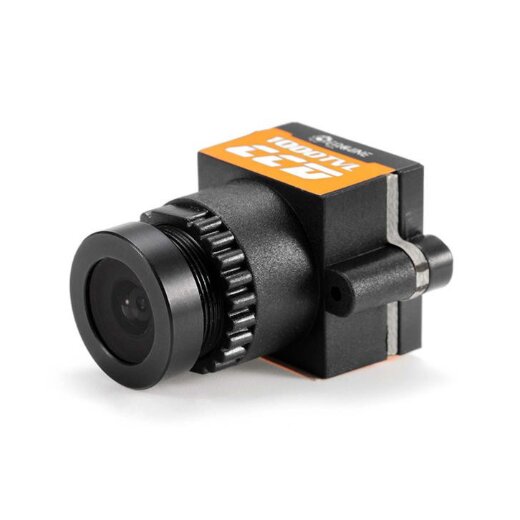
PMT Eachine 1000TVL FPV Camera
- SKU: MBS-Z1-267
- GTIN: 0658917505028
- Category: Accesoires
PMT Eachine 1000TVL FPV Camera
- 1/3 CCD
- Field of view: 110°
- 2.8 mm with IR coating
Description
The Eachine 1000TVL FPV camera is a compact, lightweight mini camera for FPV use on multicopters and other RC models. With a 1/3″ CCD sensor, 1000 TVL resolution and a fast 2.8 mm lens (110° field of view) it delivers a razor-sharp image – even in low light (0.08 Lux).
The video signal can be freely switched between PAL and NTSC. A factory-active WDR function ensures balanced contrast in difficult lighting conditions; there is no OSD menu. The wide input voltage range of 5–20 V allows operation from a wide variety of power sources, while the low power consumption makes it ideal for drones.
An included lens cover protects the lens. Thanks to its low weight of just 10.4 g and its compact form factor, the camera is also suitable for small builds.
Technical specifications
| Sensor | 1/3″ CCD |
| Resolution | 1000 TVL (PAL: 976H × 582V / NTSC: 976H × 494V) |
| Video format | PAL / NTSC (freely switchable) |
| Lens | 2.8 mm, IR-coated, M12 thread |
| Field of view (FOV) | 110° |
| Light sensitivity | 0.08 Lux / F1.2 |
| Input voltage | DC 5–20 V |
| Power consumption | 27–105 mA |
| Functions | WDR (active by default); no OSD |
| Operating temperature | 0–40 °C |
| Camera dimensions | 28 × 24.5 × 17.5 mm |
| Lens size | 17 × 14 mm |
| Weight | 10.4 g (without box and cable) |
Scope of delivery
- 1× Eachine 1000TVL FPV camera
- 1× connection cable
- 1× lens cover
Reviews
There are no reviews yet.

