


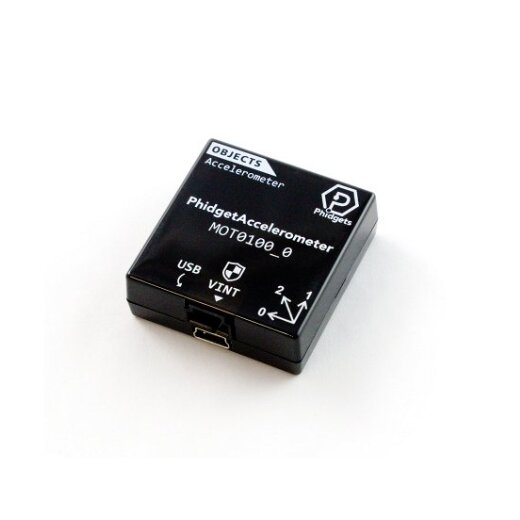
Phidget Accelerometer
- SKU: MBS-SES-430
- GTIN: 0658917504991
- HAN: MOT0100_0
- Category: Sensors
-
Manufacturers:

Phidget Accelerometer
- Acceleration in three axes
- Measuring range of up to ±8 g (78.5 m/s²)
Description
The PhidgetAccelerometer measures acceleration in three axes (x, y, z) over a range of up to ±8 g (78.5 m/s²). Typical applications include detecting the movement of an object – such as a person or a robotic vehicle – determining the direction and strength of acceleration, detecting vibration, and use as a tilt sensor.
Each reading carries an accurate timestamp, which makes plotting and advanced calculations easier. The device connects either directly via USB cable or through a VINT Hub using a Phidget cable.
Programming is handled through the Phidget22 library and is supported on common operating systems (Windows, macOS, Linux, iOS, Android) as well as numerous programming languages (C, C#, Python, Java, JavaScript, Swift and more).
Technical data
Accelerometer
| Measurement range max. | ± 8 g |
| Measurement resolution | 250 µg |
| Bandwidth | 60 Hz |
| Noise (@ 4 ms / 10 ms / 100 ms) | ± 15 mg / ± 8 mg / ± 4 mg |
| Drift max. | 10 mg |
| Bias (+15 to +30 °C) | 20 mg |
Board & connection
| Controlled by | VINT or USB |
| Driver support | Phidget22 |
| API object name | Accelerometer |
| Max. VINT communication speed | 100 kbit/s |
| Sampling speed (min. / max.) | 1 s/sample / 4 ms/sample |
| Current consumption max. | 5 mA |
| USB voltage | 4.1–5.3 V DC |
| USB speed | Full Speed |
| Operating temperature | -40 to 85 °C |
Scope of delivery
- 1× PhidgetAccelerometer (MOT0100_0)
Note: Depending on the operating mode, either a USB cable (USB-A to Mini-B) or a VINT Hub together with a Phidget cable is additionally required – these are not included and available separately.
Reviews
There are no reviews yet.

