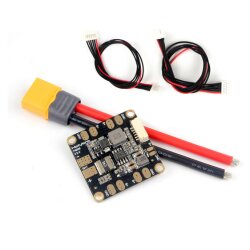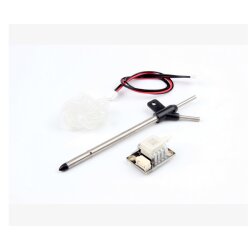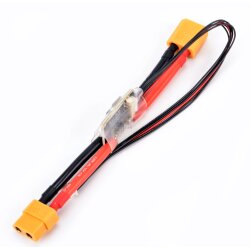

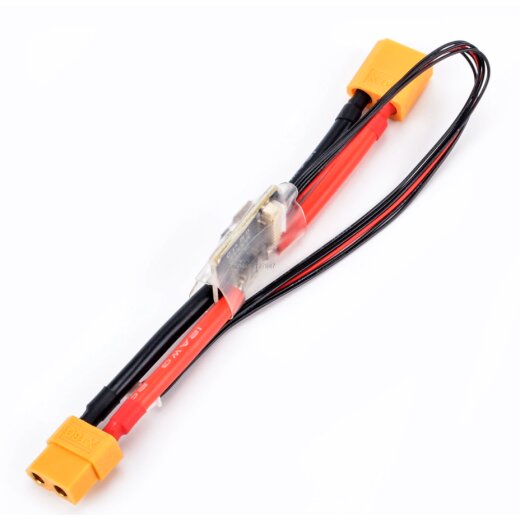
APM 2.5.2 Power Module with XT60 Plug
- SKU: MBS-PDB-15
- GTIN: 0658917500658
- HAN: FA-007
- Category: Power Distribution Boards (PDB)
-
Manufacturers:

APM 2.5.2 Power Module with XT60 Plug
- detects battery current and voltage
- Flight control board: receives two signals, calculates remaining battery power and estimates remaining flight time
- with BEC function (5.3DC, max. 3A continuous current for flight control board)
Description
The APM 2.5 Power Module is able to supply power from a LiPo battery to the APM 2.5 via a 6-pin cable and measure the battery voltage. The power module is supplied with Deans connectors and fully assembled. It is wrapped with heat shrink tubing for protection. The integrated switching regulator supplies 5.3V and max.2.25A from a 4S LiPo battery.
Function
- detects battery current and voltage
- Flight control board: receives two signals, calculates remaining battery power and estimates remaining flight time
- with BEC function (5.3DC, max. 3A continuous current for flight control board)
Technical data
- max. input voltage: 20V
- max. current measurement: up to 90A
- voltage and current measurement: configured for 5V ADC
- switching regulator outputs: 5.3V and max. 2.25A
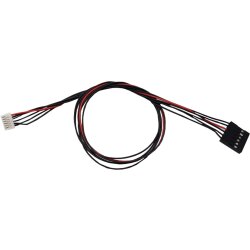
- the 6-pin DF13 cable is connected directly to the "PM" connector
Note: This power module is only designed to power the APM, an RC receiver and APM accessories. It is not intended for the operation of servos. Use the aircraft's own ECS/BEC for this purpose.
Scope of delivery
- APM 2.5.2 Power Module with XT60 Plug
Reviews
There are no reviews yet.
Others also bought: