


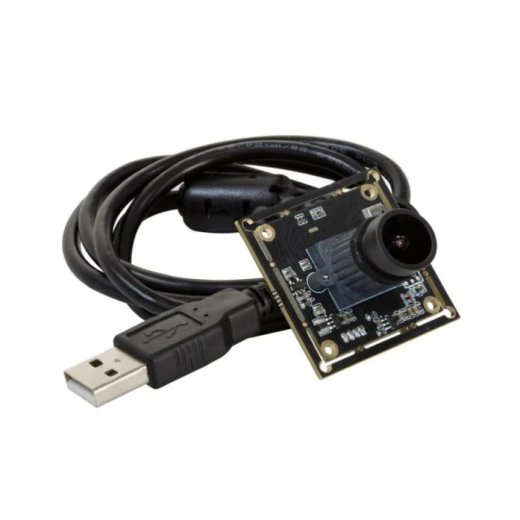
ArduCam 1080P Low Light WDR USB Camera Module
- SKU: MBS-SES-185-46
- GTIN: 05390368407166
- HAN: B0201
- Category: Sensors
-
Manufacturers:

ArduCam 1080P Low Light WDR USB Camera Module
- Low-light capable: Sony IMX291 with 80 dB WDR and 0.001 lux minimum illumination
- Plug and play: UVC-compliant under Windows, Linux, Android and macOS – no driver installation
- Compact and adaptable: 38 × 38 mm board with interchangeable M12 lens, 120° ex works
Description
Arducam B0201 – 1080p USB camera module with IMX291 and WDR
The B0201 is a compact USB 2.0 camera module based on the Sony IMX291. With 80 dB of dynamic range and a minimum illumination of 0.001 lux, it still delivers usable images where simple webcams have long given up: in backlight, at dusk and indoors with harsh differences in brightness.
As a UVC-compliant device it needs no driver. Plug it in and it works – under Windows, Linux, Android and macOS, on an industrial PC just as on a Raspberry Pi or Jetson. At 38 × 38 mm board size, with hole patterns for 34 × 34 mm and 28 × 28 mm, it fits into enclosures where a finished camera no longer has room.
A microphone is on board, and hardware H.264 encoding takes load off the host in continuous operation. The M12 lens is interchangeable, so the field of view can be matched to the application.
Your advantages at a glance
- Low-light capable: Sony IMX291 with 80 dB WDR and 0.001 lux minimum illumination
- No driver installation: UVC-compliant under Windows, Linux, Android and macOS
- Hardware H.264: 1080p at 30 fps, compressed on the module itself
- Small footprint: 38 × 38 mm board with hole patterns for 34 × 34 mm and 28 × 28 mm
- Interchangeable lens: M12 mount, fields of view from 23° to 180° achievable
- Microphone integrated: audio without additional hardware
- Wide temperature range: −20 °C to +70 °C
Technical data
| Part number | B0201 |
| Sensor | Sony IMX291, 1/2.8" colour CMOS |
| Resolution | 2 MP, 1945 × 1109 |
| Dynamic range | 80 dB |
| Minimum illumination | 0.001 lux |
| Data formats | MJPG, YUY2, H.264 |
| Frame rates | MJPG: 30 fps at 1920 × 1080 down to 320 × 240 H.264: 30 fps at 1920 × 1080 down to 320 × 240 YUV: 5 fps at 1920 × 1080, 10 fps at 1280 × 720, 30 fps at 640 × 480 |
| Lens | M12 mount, LN004 with 120° diagonal, integral IR cut filter |
| Focusing range | 1 m to infinity |
| Automatic functions | saturation, contrast, acutance, white balance, exposure |
| Audio | 1 microphone, dual channel on request |
| Interface | USB 2.0, UVC-compliant; board connector B4B-ZR(LF)(SN) |
| Operating systems | Windows, Linux, Android, macOS with UVC |
| Power supply | 5 V via USB, max. 300 mA |
| Dimensions | 38 × 38 mm, hole pattern compatible with 34 × 34 mm and 28 × 28 mm |
| Cable length | 1 m |
| Operating temperature | −20 °C to +70 °C |
Typical applications
- Robotics and machine vision with limited installation space
- Day and night surveillance with widely changing lighting conditions
- Process monitoring, for example on a 3D printer or machine
- Video conferencing and teleoperation
- Dashcam and in-vehicle applications
Note on lens selection
The LN004 with a 120° diagonal is fitted ex works. The M12 mount accepts focal lengths from 1.7 mm to 16 mm – on the 1/2.8" sensor that corresponds to fields of view between 23° and 180°. If you want to change the lens, talk to us before ordering: Arducam offers the swap at the factory, which saves you the refocusing.
Scope of delivery
- 1× Arducam B0201 camera board, 2 MP IMX291
- 1× USB 2.0 cable, 1 m
Reviews
There are no reviews yet.

