


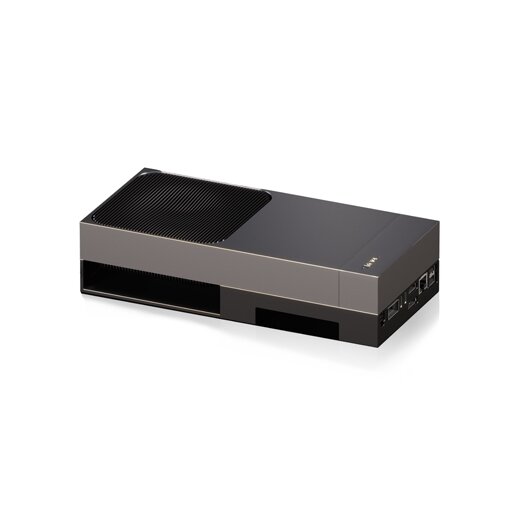
NVIDIA Jetson AGX Thor Developer Kit
- SKU: MBS-ENTB-122
- GTIN: 0658917504113
- HAN: JET AGX THOR KIT
- Category: Development Boards
-
Manufacturers:

NVIDIA Jetson AGX Thor Developer Kit
- FP4 (4-bit) and Transformer Engine
- Up to 2,070 TFLOPS
- Multi-instance GPU (MIG)
- Operating range approx. 40 W to 130 W
Description
The NVIDIA Jetson AGX Thor Developer Kit is a high-performance development platform specifically designed for Edge AI and robotics systems. It is intended for developers, researchers, and companies aiming to implement physical intelligence (“Physical AI”), such as humanoid robots, autonomous machines, industrial automation, or intelligent peripherals.
The kit includes the module (Jetson T5000) on a reference carrier board with multiple interfaces, allowing developers to get started immediately with sensor connections, data networks, storage, I/O, and AI acceleration.
NVIDIA positions the kit as the “robot brain” for future robotics systems, offering up to 2,070 TFLOPS (FP4 – Sparse) of AI computing power at 130 W operation.
Technical Data
- AI Performance: Up to 2,070 TFLOPS (FP4 – Sparse)
- GPU: NVIDIA Blackwell architecture, 2,560 CUDA cores, 96 5th-generation Tensor cores
- CPU: 14-core ARM® Neoverse®‑V3AE 64-bit (1 MB L2 per core, 16 MB shared L3)
- Memory: 128 GB LPDDR5X, 256-bit, ~273 GB/s bandwidth
- Storage: 1 TB NVMe, M.2 Key M slot
- Video Encode/Decode: Encode: up to 6× 4K@60 (H.265), Decode: up to 4× 8K@30 (H.265)
- Camera Interfaces: Up to 20 cameras via HSB; up to 6 cameras via 16× MIPI CSI‑2; up to 32 cameras with Virtual Channels C‑PHY/D‑PHY
- Networking / I/O: 4× 25 GbE QSFP Plus, 1× 5 GbE RJ‑45, HDMI, DisplayPort, USB‑A, USB‑C, CAN header, etc.
- Power Consumption: Approx. 40 W – 130 W depending on mode
- Mechanical (Kit): 243.19 mm × 112.40 mm × 56.88 mm (height including cooling)
Key Features & Innovations
- FP4 (4-bit) and Transformer Engine: Supports native FP4 quantization and a Transformer Engine that dynamically switches between FP4 and FP8, ideal for large language and generative AI models at the edge.
- Multi-Instance GPU (MIG): The GPU can be partitioned to run multiple isolated instances in parallel, providing deterministic performance for mixed workloads.
- Sensor & Network I/O for Robotics: High-speed networking, multiple camera interfaces, automation modules – specifically designed for “Physical AI.”
- High Energy Efficiency: Up to 3.5× more efficient than its predecessor, the Jetson AGX Orin.
Use Cases
- Humanoid robots or robots with high autonomy
- Logistic and industrial automation with heavy sensor and AI requirements
- Edge AI systems with multiple cameras, LiDAR, and high data throughput
- Generative AI at the edge, e.g., language or image models running locally on robots
Notes
- Power consumption can reach ~130 W, which should be considered for mobile or battery-powered systems.
- The kit is primarily intended for development and prototyping; for mass production, the module or a custom carrier may be required.
- Due to its high performance, careful planning of cost, cooling, and system integration is necessary.
Scope of delivery
- AGX Thor
- Carrier Board
- Power supply
- Cooling system and cables
- Software
| Item information | Value |
|---|---|
| Shipping weight: | 2,50 kg |
| Item weight: | 2,00 kg |
Reviews
There are no reviews yet.

