






Holybro Standard Precision Digital Airspeed Sensors
- SKU: MBS-SES-440
- Category: UAV / Pixhawk
-
Manufacturers:

Holybro Standard Precision Digital Airspeed Sensors
- True airspeed: the basis for stall protection, wind estimation and the VTOL transition – GPS alone is not enough
- Digital and interference-free: I²C instead of an analogue signal, temperature compensated, approved for all Pixhawk controllers with ArduPilot and PX4
- Freely combinable: three sensor grades and two pitot tube lengths – sensor and tube can also be reordered individually
Description
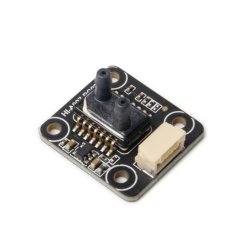
Holybro Digital Airspeed Sensor – pitot sensors for fixed-wing and VTOL
GPS gives you speed over ground. What keeps a fixed-wing aircraft in the air, however, is its speed relative to the air – and in a headwind or tailwind the two figures can be far apart. The airspeed sensor measures exactly that, via a pitot tube: it compares dynamic and static pressure and derives the actual airflow velocity from the difference.
For the autopilot this is the basis for dependable stall protection, sound wind estimation and a cruise that genuinely sits in the efficient range. On VTOL platforms there is the transition from hover to forward flight on top of that – without an airspeed measurement, that moment is pure guesswork.
Every variant works digitally: the reading is digitised at the sensor itself and transmitted over I²C. This removes the interference that analogue sensors pick up over long cable runs inside the fuselage. Temperature compensation is included in every version.
Your advantages at a glance
- Digital rather than analogue: digitised at the sensor – no interference picked up over long cable runs in the fuselage
- Three sensor grades: AS1318C, MS4525DO and MS5525DSO – from the economical standard solution to high-resolution measurement
- Temperature compensated: standard across all variants, with ±1.5 °C temperature accuracy
- Light and compact: 2.6 to 4.1 g module weight – negligible within your weight budget
- Frugal: around 1.4 to 3 mA current draw
- Plug and play: I²C over JST-GH 4-pin, approved for all Pixhawk flight controllers running ArduPilot and PX4
- Two pitot tube options: PT40 and PT60 – matched to nose or wing mounting
- Individually replaceable: sensor and pitot tube are also available separately
Variants at a glance
| SKU | Version | Scope of delivery |
| 19017 | AS1318C, sensor only | sensor, 40 cm tubing, GH 4-pin cable |
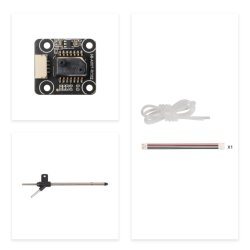
| 19018 | AS1318C with PT40 | sensor, PT40 pitot tube, 40 cm tubing, GH 4-pin cable |
| 19019 | AS1318C with PT60 | sensor, PT60 pitot tube, 100 cm tubing, GH 4-pin cable |
| 19007 | MS4525DO, sensor only | sensor, 40 cm tubing, GH 4-pin cable |
| 19003 | MS4525DO with PT40 | sensor, PT40 pitot tube, 40 cm tubing, GH 4-pin cable |
| 19008 | MS4525DO with PT60 | sensor, PT60 pitot tube, 100 cm tubing, GH 4-pin cable |
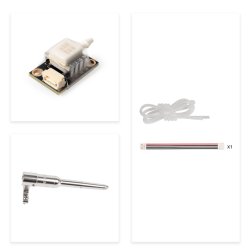
| 19009 | MS5525DSO, sensor only | sensor, 100 cm tubing, GH 4-pin cable |
| 19010 | MS5525DSO with PT40 | sensor, PT40 pitot tube, 40 cm tubing, GH 4-pin cable |
| 19011 | MS5525DSO with PT60 | sensor, PT60 pitot tube, 100 cm tubing, GH 4-pin cable |
| 32022 | PT40 pitot tube only | PT40 pitot tube, 40 cm tubing |
| 32023 | PT60 pitot tube only | PT60 pitot tube, 100 cm tubing |
Technical data compared
| Feature | AS1318C | MS4525DO | MS5525DSO |
| Measuring range | 1 psi | 1 psi | 1 psi |
| Burst pressure | 10 psi | 10 psi | 20 psi |
| Total error band | ±1 % FSS | ±1 % FSS | ±2.5 % FSS |
| Pressure resolution | 14 bit | 14 bit | 24 bit |
| Temperature resolution | 11 bit | 11 bit | 24 bit |
| Update time | 0.5 ms | 0.5 ms | 0.48 to 9.04 ms |
| Temperature accuracy | ±1.5 °C | ±1.5 °C | ±1.5 °C |
| Compensated range | 0 to 60 °C | −10 to 85 °C | 0 to 85 °C |
| Operating temperature | −20 to 85 °C | −25 to 105 °C | −40 to 125 °C |
| Current draw | approx. 3 mA | approx. 3 mA | approx. 1.4 mA |
| Dimensions | 17 × 23 × 13 mm | 17 × 23 × 13 mm | 20 × 22 × 11.4 mm |
| Module weight | 4.1 g | 4.1 g | 2.6 g |
| Interface | I²C, address 0x28 | I²C, address 0x28 | I²C, address 0x76 |
| Connector | JST-GH, 4-pin | JST-GH, 4-pin | JST-GH, 4-pin |
| Mounting | M3 / 6-32 | M3 / 6-32 | M3 / 6-32 |
A note on selection
Resolution is not accuracy. The MS5525DSO resolves considerably more finely at 24 bit, but its total error band of ±2.5 % FSS is wider than that of the two 14-bit sensors at ±1 % FSS. For applications that depend on the absolute value – stall warning close to minimum speed, for instance – the MS4525DO is the safer choice. Where fine changes and smooth signal traces matter, such as wind estimation or data analysis, the MS5525DSO plays to its resolution. Its wider temperature range and lower current draw speak for it as well.
Two sensors on the same bus. The AS1318C and the MS4525DO both occupy I²C address 0x28 and therefore cannot be operated together on one bus. The MS5525DSO uses 0x76 and can be combined with either of them – useful if you want redundant measurement.
PT40 or PT60. The two pitot tubes differ in the length of tubing supplied: 40 cm with the PT40, 100 cm with the PT60. What decides it is the run from the tube's mounting point to the sensor. With the pitot tube in the nose and the sensor directly behind it, PT40 is enough; for wing or boom mounting you need PT60.
A note on installation
The pitot tube has to sit in clean, undisturbed airflow – ahead of the propeller wash, outside the boundary layer and clear of a wing's downwash. A poor position distorts the reading more than any difference between the three sensors. The tubing should be routed without kinks and without a low point where condensation can collect. We are happy to advise on positioning for your platform.
Typical applications
- Fixed-wing aircraft running ArduPilot or PX4 – stall protection and efficient cruise
- VTOL platforms – a sound decision at the transition into forward flight
- Wind estimation for mission planning and range calculation
- Survey and mapping flights with tight path requirements
- Research and flight testing where reliable measurement data is needed
- Spares holding – sensor and pitot tube can be reordered individually
Scope of delivery
Depending on the variant selected – see the table “Variants at a glance”. The complete sets contain the sensor module, pitot tube, silicone tubing and JST-GH 4-pin cable. The sensor-only variants come without a pitot tube, the pitot-only variants without sensor and cable.
Reviews
There are no reviews yet.

